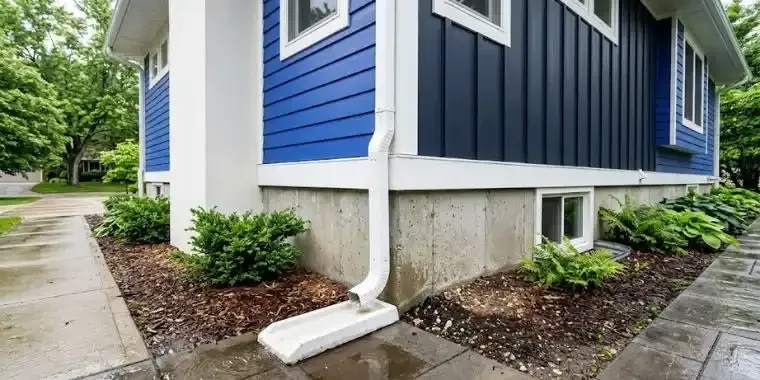
If you've lived in Franklin for more than a rainy season, you've probably noticed the pattern: the basement stays bone dry for weeks, and then a multi-day rain event rolls through and water shows up along the wall base by the second or third day. It happens to well-maintained homes in Westhaven just as often as it happens to older houses near downtown, which is usually the homeowner's first clue that it isn't a construction defect. It's geology.
The Ground Under Franklin Isn't Like Most Places
Middle Tennessee, including Williamson County, sits on karst terrain, ground shaped by limestone bedrock that dissolves slowly over geologic time, leaving voids, channels, and irregular rock surfaces underground. On top of that limestone sits a layer of clay-heavy soil that behaves very differently depending on how much water it's holding. Dry clay is dense and relatively stable. Saturated clay swells, sometimes significantly, and that swelling pushes outward against anything in its way, including a basement or crawlspace foundation wall.
This is the mechanism behind a lot of what gets called "basement flooding" in Franklin: it's rarely a burst pipe or a plumbing failure inside the house. It's groundwater and rain saturation building pressure against the outside of the foundation until it finds a way in, usually through a hairline crack, a porous block joint, or the seam where the wall meets the slab.
Why It Only Happens After Heavy Rain, Not Every Rain
A light, brief rain rarely causes problems because the soil has time to absorb and drain it without ever reaching full saturation. The pattern changes with a multi-day, high-volume rain event, exactly what Middle Tennessee sees most often in March through May. By day two or three of sustained rain, the clay around a foundation is holding as much water as it can, and any additional rain has nowhere to go but sideways, against the wall, under hydrostatic pressure. That's the specific moment most Franklin basement flooding calls come in.
It's also why two houses on the same street can have completely different experiences with the same storm. Grading, gutter and downspout discharge points, the condition of any existing exterior drain tile, and even how compacted the soil is right against the foundation all affect how much pressure actually builds up at any one wall.
What Actually Fixes It
The honest answer depends on where the water's entry point actually is, which is why a real basement waterproofing assessment starts with tracing water to its source rather than jumping straight to a sealant. Three fixes come up most often in Franklin:
- Grading and downspout correction. The least invasive fix, and sometimes the whole fix, if surface water is being directed toward the foundation instead of away from it.
- Interior drain tile paired with a sump pump. Collects water that's already made it past the wall and moves it back outside before it can pool. This is the most common fix for karst-driven hydrostatic pressure specifically, because it's designed to handle a pressure spike, not just steady seepage.
- Exterior excavation and membrane systems. More invasive and more expensive, but addresses the water before it ever reaches the wall. Usually reserved for more severe or long-standing intrusion.
A Sump Pump's Role In Karst-Driven Flooding
A sump pump's role in this whole picture is bigger than people expect. Drain tile collects the water, but the pump is what actually gets it back outside, and a pump that's undersized for Franklin's rain intensity will fail at exactly the moment it matters most. If your basement has flooded more than once, it's worth having sump pump capacity checked alongside any waterproofing work, since a properly sized system built for local rainfall intensity is what actually prevents a repeat.
Dealing with a wet basement right now?
☎ (615) 616-0512How Downtown Franklin's Older Lots Add A Second Factor
Downtown Franklin's 722-acre historic district sits close enough to the Harpeth River that some basements there deal with a second contributing factor beyond karst clay alone: a temporarily elevated water table during peak spring flow. A foundation that stays dry through a normal rain but takes on water during a multi-day, high-volume event is often dealing with both hydrostatic pressure from clay soil and a rising water table pushing from below at the same time, which is why a proper assessment checks both grading and the property's proximity to natural drainage paths before settling on a fix. Older homes on smaller, tighter lots near downtown also tend to have less room for exterior drainage work, which sometimes tips the recommendation toward an interior drain tile system over a full exterior excavation simply because of what the property physically allows.
Quick Answers
Does every Franklin basement eventually have water issues? No. Plenty of well-graded properties with good downspout discharge never see intrusion, even through heavy storms. Karst-clay soil creates the risk, it doesn't guarantee the outcome.
Is a wet basement a sign my foundation is failing? Not by itself. Water intrusion and structural failure are related but different problems. Persistent water alongside growing cracks or uneven floors is worth a closer look, isolated seepage after heavy rain usually isn't.
Can I fix this myself with a store-bought sealant? Surface sealants sometimes reduce minor seepage temporarily, but they don't address hydrostatic pressure building behind the wall, which is why sealed walls in karst-soil homes often fail again within a season or two.
A Note On Sinkhole Risk
Karst terrain does carry a real, if less common, secondary risk beyond basement seepage: sinkholes. Areas throughout Williamson County, including parts of Brentwood, have documented sinkhole activity tied to this same limestone-dissolution process. Persistent settling, new cracks that keep growing, or a sudden depression in the yard alongside basement water intrusion is worth having evaluated rather than treated as a routine wet-basement call.
New Construction Isn't Immune
One thing that surprises homeowners in newer developments: a basement that's only a few years old can still flood. Freshly disturbed, graded soil around new construction hasn't had decades to settle and compact the way older lots have, and that settling process can undo drainage that passed inspection at the time of the final walkthrough. If you're in a newer build and seeing early water intrusion, it doesn't necessarily mean anything was built wrong, it often just means the ground underneath is still finding its equilibrium.
The Bottom Line
A wet basement after a big storm in Franklin is common enough that it shouldn't be treated as a mystery or a one-off bad break. It's a predictable outcome of building on karst-clay soil, and it responds well to a properly diagnosed fix, grading correction, drain tile, a right-sized sump pump, or some combination of the three, once someone actually traces where the water is coming from instead of guessing.
Have a plumbing issue in Franklin, Brentwood, or Spring Hill?
☎ (615) 616-0512