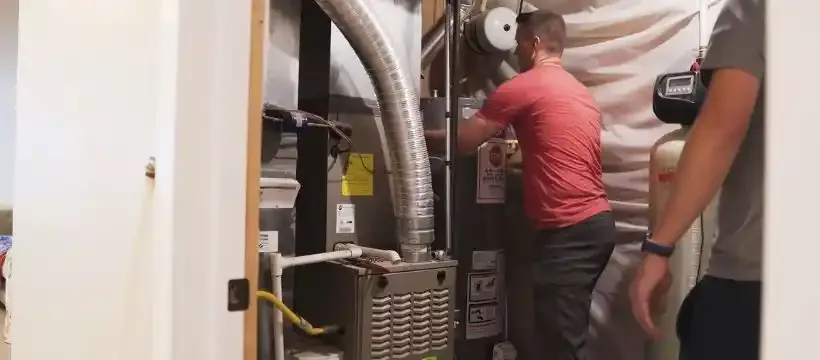
 Overview
Why Choose Us For Water Heater Replacement
Same-Day Install
Most standard tank replacements are completed the day you call.
All Major Brands
Rheem, A.O. Smith, Rinnai, and Navien stocked and installed.
Haul-Away Included
The old tank is removed and disposed of at no extra charge.
Warrantied Labor
Installation work is backed by our workmanship warranty.
Homes in Franklin's historic core built before the mid-1960s were often plumbed for a standard 40-gallon tank in a small utility closet, which limits options if a homeowner wants to size up. Newer construction in Westhaven, Berry Farms, and the Cool Springs corridor generally has more room and better venting access, which opens up tankless as a realistic option. We check venting, gas line sizing, and electrical service before quoting a tankless conversion rather than assuming it will fit.
Common SignsSigns You Need Water Heater Replacement
Tank Is Actively Leaking
Water pooling at the base almost always means the tank itself has failed internally.
Unit Is Over 10-12 Years Old
Most tanks are rated for a 10 to 15 year service life before failure risk climbs.
Repair Cost Approaches Replacement
When a repair quote gets close to half the cost of a new unit, replacement is usually the better spend.
Household Outgrowing Capacity
A growing family running out of hot water regularly is a sizing problem, not a repair problem.
Ready To Replace Your Water Heater?
Get a same-day quote before any work begins.
How Installation Works
Inspect
We check the existing tank, venting, gas or electrical connections, and shutoff valves.
Quote
One flat price for the full replacement, presented before any work starts.
Install
Old unit removed, new unit set, connected, and pressure-tested.
Test
Full system check for leaks, proper venting, and correct temperature.
Which Fits Your Franklin Home
Traditional Tank
- Lower upfront cost
- Simpler installation in most homes
- Limited hot water supply during high demand
- Typical 10-15 year lifespan
Tankless
- Continuous hot water on demand
- Lower monthly energy cost over time
- Compact wall-mounted unit frees floor space
- Typical 20+ year lifespan with maintenance
What Water Heater Replacement Costs
Tank replacements sit toward the lower end, tankless conversions with new venting or gas line work sit toward the higher end.
Water Heater Replacement In Franklin, TN
We size every replacement to the household, not just the footprint of the old tank. A three-bedroom home in Brentwood running two bathrooms and a dishwasher on the same schedule every morning needs more real capacity than the 40-gallon unit that came with the house a decade ago. Walking through actual usage before quoting a size is how we avoid selling a tank that leaves someone with a cold shower six months from now.
Franklin's Building Department generally requires a permit for water heater replacement when the work changes venting, gas line sizing, or moves the unit's location, but a like-for-like tank swap in the same spot is typically a more straightforward process. We confirm what a specific job actually requires before quoting, rather than defaulting to the most complicated version of the job.
For tankless conversions specifically, the real question is almost always the existing gas line. A standard 40-gallon tank runs on a 1/2 inch gas line in most Franklin homes, while a tankless unit generating hot water on demand typically needs a 3/4 inch line to deliver enough BTU output, especially for larger tankless models sized for a full household. We check the existing line size on-site before quoting a tankless conversion, since an undersized line that isn't upgraded is the most common reason a new tankless installation underperforms.
FAQsCommon Questions
Most standard tank replacements are completed the same day for calls placed before early afternoon.
Yes, removal and disposal is included in every replacement job.
It depends on existing gas line size and venting. We check both before recommending a conversion, since retrofitting an undersized line adds cost.
Yes, you approve a flat price before any work begins.
Yes, most Franklin homes built before the 1990s were plumbed for a standard 40-gallon unit in a small utility closet. We work within that footprint or discuss options for expanding it if a homeowner wants a larger tank.