Franklin proper is served by the City of Franklin Water Management Department, drawing surface water from the Harpeth River and supplementing through the Harpeth Valley Utility District. That covers most of the city. It doesn't cover all of Williamson County. Properties further out, particularly older or more rural parcels, are more likely to be running on a private well, and that changes a fair amount about how their plumbing gets maintained.
This distinction catches some buyers off guard, particularly anyone relocating from a market where private wells are rare and municipal service is simply assumed. Williamson County's continued growth has extended municipal coverage over the years, but plenty of established, well-outside-the-city properties were never connected and were never intended to be, since a working well and septic system were considered complete, self-sufficient infrastructure at the time those properties were developed.
How To Tell Which System You're On
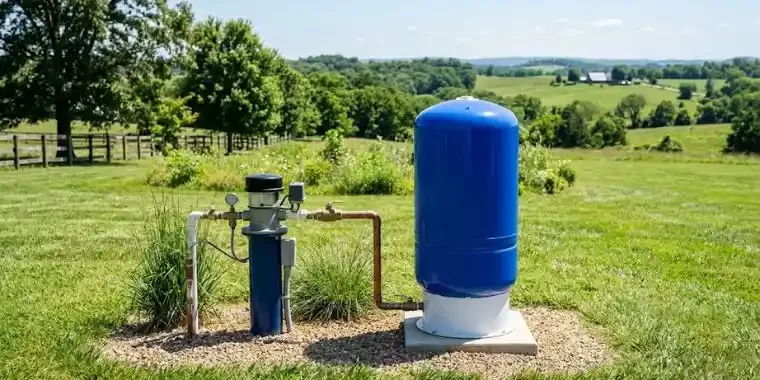
If you're not sure, there are a few practical clues: a water meter near the street or a monthly water utility bill points to municipal service. A pressure tank, typically a squat metal or fiberglass tank in a basement, utility closet, or well house, points to a private well. Property records and a home inspection report from when you purchased the property will also confirm it directly if you're still uncertain.
What's Genuinely Different About Well Water
- You own the entire system. There's no utility company responsible for water quality or supply reliability. The well, pump, pressure tank, and all associated equipment are the homeowner's responsibility to maintain.
- Pressure comes from a pump and tank, not a municipal main. A well pump failure means no water at all, not just reduced pressure, which is a meaningfully different kind of emergency than a municipal customer ever experiences.
- Water quality varies more property to property. Municipal water is treated and tested centrally. Well water quality depends on the specific aquifer a well draws from, which can genuinely differ between two properties a short distance apart on Williamson County's karst geology.
- No fluoridation or municipal treatment. Neither good nor bad on its own, just a different starting point that some homeowners choose to address with their own filtration.
Common Well System Problems We See
Pressure tank issues are the most frequent call, usually a waterlogged tank that's lost its air cushion, causing the pump to cycle far more often than it should and wearing it out faster. Beyond that, declining pressure, cloudy or sediment-heavy water, or a pump that runs constantly without ever quite catching up are the patterns worth having checked before the system fails outright.
Should You Filter Well Water?
It depends entirely on what's actually in it, which is why testing matters more for a well than it does for municipal customers who already receive treated water. A sediment filter addresses particulate matter. A whole-home filtration or softening system addresses hardness and other water quality factors depending on what a test actually turns up. We'd rather test first than guess at what equipment a specific well needs.
Not sure if your property is on a well?
☎ (615) 616-0512What A First Well System Assessment Actually Covers
For a buyer inheriting an unfamiliar well system, or a longtime owner who's simply never had one done, a baseline assessment typically covers pump condition and estimated remaining lifespan, pressure tank function and air charge, current system pressure against expected residential targets, and a basic water quality read to flag anything worth a fuller test. This gives a homeowner an actual starting point rather than operating on assumptions, and it's a meaningfully different position to be in than discovering a failing pump for the first time during an actual outage with no water at all.
Quick Answers
How deep are typical wells in Williamson County? Depth varies considerably by specific location given the karst limestone bedrock, which is exactly why documented well records matter more here than in areas with more predictable, uniform aquifers.
Can a well run dry? It's possible during extended drought conditions or if a well was drawing from a limited local water source, though it's relatively uncommon for established wells with a history of reliable yield.
Do I need to test well water regularly, or just once? Annual testing is a reasonable baseline for bacterial content, with a fuller mineral and quality test less frequently unless something specific changes, like a new odor, taste, or color.
What happens if I move into a home with a well and no maintenance records? A baseline assessment is the right first step. Without history, treating the system as an unknown quantity and getting it properly evaluated is safer than assuming it's fine simply because water is currently flowing.
If Your Property Has Well Water And Septic Together
This is common for outlying Williamson County properties that predate municipal service reaching that area. Both systems deserve their own maintenance attention, a well pump and pressure tank on one side, and scheduled septic pumping on the other, since neither system depends on or protects the other. Treating them as a connected pair mentally, "self-sufficient water in, self-sufficient water out," is a reasonable way to think about the ongoing maintenance both sides genuinely need.
The Bottom Line
If you're on a well and you've never had it properly assessed, whether that's a first-time buyer inheriting a system with no maintenance history or a longtime owner who's simply never had it checked, it's worth a baseline visit. Knowing your pump's condition and your water's actual quality before something fails is a meaningfully better position than finding out during an actual outage.
Municipal water customers rarely think about their supply until a bill arrives. Well owners genuinely can't afford that same level of inattention, since the system that delivers water to the tap is entirely theirs to maintain, with no utility company checking in behind the scenes.
None of this makes well ownership a burden, plenty of Williamson County homeowners have run reliable private systems for decades without major issue. It simply means the maintenance responsibility sits in a different place than it does for a municipal customer, and treating it that way from the start avoids most of the surprises that catch new well owners off guard.
Have a plumbing issue in Franklin, Brentwood, or Spring Hill?
☎ (615) 616-0512