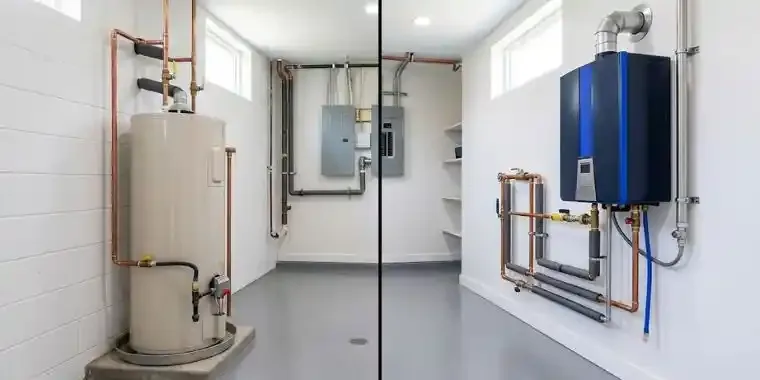
Every water heater replacement conversation in Franklin eventually gets to the same question: should this be tankless? The marketing around tankless units is compelling enough that it's worth slowing down and looking at what actually changes in a real home, not just the brochure version.
This decision tends to come up at a specific, slightly stressful moment, an existing tank has just failed or is clearly on its way out, and a homeowner researching a replacement online runs headlong into tankless marketing promising endless hot water and lower bills. That's not a bad time to consider it, but it is a time when a rushed decision is more likely, which is exactly why laying out the honest tradeoffs matters before committing to the higher upfront cost.
What Tankless Actually Solves
The core advantage is genuine: a tankless unit heats water on demand rather than storing and reheating a fixed volume, which means it doesn't run out the way a tank does when three showers and a dishwasher cycle happen back to back. For a larger household or a home with back-to-back morning routines, that's a real quality-of-life improvement, not just a marketing point.
Tankless units also tend to last considerably longer than tank units, often cited in the 15 to 20+ year range compared to 8 to 12 for a standard tank, and they take up meaningfully less physical space, mounted on a wall rather than sitting on the floor.
What The Brochures Leave Out
The upfront cost is real and it's higher, both for the unit itself and often for the installation, especially in an existing home. Tankless units generally need a larger gas line than a standard 40-gallon tank runs on, and retrofitting that line in an older Franklin home, particularly in the historic core where original supply lines are already tighter, can add real cost to a conversion that a straightforward tank swap wouldn't need. We check existing gas line size before quoting a tankless installation, because an undersized line that isn't upgraded is the single most common reason a new tankless unit underperforms and disappoints the homeowner who paid extra for it.
The Factor Almost Nobody Mentions: Septic Systems
If your property is on a septic system rather than Franklin's municipal sewer, and that's a real possibility for properties on the outer edges of Williamson County, there's a practical consideration worth thinking through before going tankless. A tank water heater runs out of hot water, which naturally limits how long a shower or a load of laundry runs. A tankless unit doesn't run out, which means it will happily supply unlimited hot water for as long as someone leaves a tap running. For a household on septic, particularly with teenagers or long-shower habits, that unlimited supply translates directly into more water reaching the septic system than the household was previously sending it, which is worth factoring into your septic maintenance schedule if you make the switch.
Weighing tank versus tankless for your home?
☎ (615) 616-0512What Retrofitting Actually Involves In An Older Franklin Home
Beyond gas line sizing, a tankless retrofit in a pre-1970s Franklin home often needs a look at venting too. Tankless units generally require a different venting configuration than a standard atmospheric tank, sometimes direct venting through an exterior wall rather than the existing chimney-style flue a home may already have. This isn't a dealbreaker, but it's additional scope that a straightforward tank swap doesn't carry, and it's exactly the kind of detail that turns an advertised "simple upgrade" into a bigger project once a contractor is actually on-site. We walk through venting requirements as part of any tankless quote, rather than pricing the unit alone and leaving venting as a surprise add-on.
Quick Answers
Can I put a tankless unit in the exact spot my tank is now? Sometimes, but venting and gas line routing sometimes make a nearby wall-mounted location more practical than the old tank's footprint.
Do tankless units need more maintenance? They need periodic descaling, typically annual in a moderately hard water market like Franklin, but require no anode rod replacement, a maintenance item tank units do need.
Is tankless worth it if I'm planning to sell in a few years? It depends on the buyer pool. Some buyers value it as an upgrade, others are indifferent. If resale timing is short, a standard tank replacement is usually the more cost-effective choice.
Does going tankless actually lower my utility bill? Often modestly, since a tankless unit isn't continuously reheating stored water the way a tank does. The savings are real but usually gradual, not dramatic enough to offset the higher upfront cost quickly on their own.
A Straightforward Way To Decide
Tank makes more sense when: the home is on septic and usage habits run long, the existing gas line and venting are already sized appropriately, upfront cost is the priority, or the household's hot water demand isn't consistently maxing out a properly sized tank.
Tankless makes more sense when: the household regularly runs out of hot water with the current tank, there's room in the budget for gas line and venting upgrades if needed, floor space matters, or a longer 15-20 year lifespan is worth the higher upfront cost.
What We Actually Recommend
We don't default to selling tankless as the automatic upgrade, because for a lot of Franklin households it isn't. A correctly sized standard tank, replaced on a reasonable schedule with attention to the anode rod, solves the vast majority of hot water complaints at a lower total cost. Tankless earns its price tag for specific situations: households that are actually running out of hot water, homes where space is genuinely tight, or homeowners planning to stay long enough to benefit from the longer lifespan. The honest first step either way is a real usage conversation before anyone commits to a number.
Whichever direction you lean, the gas line and venting assessment is worth doing before, not after, you've settled on a specific unit, since it's the piece most likely to change the actual installed cost from the number on a sales flyer.
A short, honest usage conversation before committing to either option consistently produces a better outcome than starting from a specific product and working backward to justify it, regardless of which type of unit you end up choosing.
Have a plumbing issue in Franklin, Brentwood, or Spring Hill?
☎ (615) 616-0512