Franklin's historic core has genuine pre-1960s housing stock, and a meaningful share of it was originally plumbed with galvanized steel supply lines, the standard material of the era before copper and later PEX took over. Galvanized pipe wasn't a bad choice when it was installed. It was simply never designed to last as long as the homes it's still running through today.
What makes this a genuinely common conversation in Franklin specifically, rather than an occasional oddity, is how much of the historic district's original housing stock is still standing and still occupied. Unlike markets where older neighborhoods were largely redeveloped, Franklin's downtown core has retained much of its original character, which means a meaningful share of local homes are approaching, or well past, the point where their original supply lines were ever expected to last.
Why Galvanized Pipe Fails
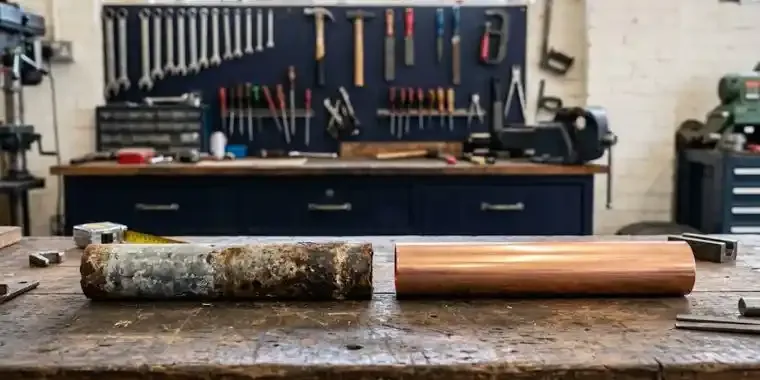
Galvanized pipe is steel with a zinc coating meant to resist corrosion. Over decades, that zinc coating wears away, and once it does, the steel underneath starts rusting from the inside, where nobody can see it happening. The corrosion narrows the pipe's interior diameter gradually, which is why declining water pressure is often the earliest sign, long before an actual leak shows up. Eventually the corrosion weakens the pipe wall enough that a pinhole leak develops, often at a joint or an elbow where flow and turbulence accelerate the wear.
The Warning Signs, In Order Of How They Usually Show Up
- Gradually declining water pressure. Usually the first sign, and easy to write off as normal, since it happens slowly enough that a homeowner adjusts without noticing.
- Discolored water, especially after periods of non-use. Rust-tinged water first thing in the morning or after returning from vacation is a classic sign of internal corrosion.
- A first pinhole leak. Often treated as an isolated incident and repaired on its own, which is reasonable the first time.
- A second, unrelated leak. This is the real signal. One leak is a repair. A second leak somewhere else in the system within a year or two means the pipe material itself has reached end of life, not that you had bad luck twice.
Repair Or Repipe: How The Decision Actually Gets Made
A single pinhole leak in an otherwise functioning system is a straightforward repair, not a reason to repipe the whole house. The calculation changes once a pattern shows up: multiple unrelated leaks, system-wide pressure decline, or discolored water from more than one fixture. At that point, continuing to patch individual failures usually costs more over a few years than committing to a full repipe once, and it comes with the added risk of a leak happening somewhere less convenient, inside a wall, above a finished ceiling, while nobody's home.
Dealing with a second unexplained leak?
☎ (615) 616-0512What A Home Inspection Might Have Missed
Galvanized pipe condition is genuinely difficult to assess from a standard visual home inspection, since the corrosion happens on the inside of the pipe where nobody can see it without specialized equipment. A home inspector can note the presence of galvanized supply lines and their approximate age, but confirming actual internal condition, and therefore realistic remaining lifespan, usually requires either a pressure and flow test or simply tracking the pattern of leaks over time as they occur. If you bought an older Franklin home and the inspection report simply noted "galvanized supply lines, original," that's a flag worth taking seriously even without any leaks yet, since it tells you the pipe's age but not how much corrosion has already happened inside it.
Quick Answers
How much does a repipe actually save compared to ongoing repairs? It depends on frequency, but a home with two or more unrelated leaks in a short span has often already spent a meaningful fraction of a repipe's cost on individual repairs, with the underlying problem still unresolved.
Can a repipe be done in stages instead of all at once? In some cases, yes, prioritizing the most at-risk sections first, though a full repipe is generally more cost-effective as a single project than staged work spread across multiple visits.
Will my water pressure improve after a repipe? Usually, yes, noticeably. Corroded galvanized pipe narrows over time, and new PEX or copper restores the pipe's full original diameter and flow.
How long does a whole house repipe typically take? Most residential repipe projects are completed within a few days, depending on home size and how many fixtures need to be connected, with drywall patching sometimes scheduled as a short follow-up.
What About Homes With Polybutylene Instead?
A smaller number of Franklin-area homes, particularly some built in the 1980s and early 1990s, were plumbed with polybutylene rather than galvanized steel. Poly-B is a different material with a different failure mode, prone to fitting and joint failure rather than internal corrosion, but it carries a similar practical outcome: many insurers and inspectors treat confirmed polybutylene as a liability regardless of current symptoms, since failure is considered a matter of when rather than if. If you're not sure which material your home has, it's worth confirming before it becomes a surprise during a home sale or refinance.
PEX Or Copper: The Two Realistic Replacement Options
PEX is flexible, generally less expensive installed, and more resistant to freeze damage than rigid copper, which makes it the more common choice for most Franklin repipe projects today. Copper has a longer historical track record and some homeowners simply prefer it, particularly for exposed runs. Neither is wrong, and a good repipe conversation lays out the honest tradeoffs of both rather than pushing a single default.
What A Repipe Actually Involves
The part that worries homeowners most is usually the wall damage, and it's a fair concern. A well-planned repipe routes new lines to minimize the number of openings needed, leaving clean, patch-ready cuts rather than tearing into every wall in the house. It's a bigger project than a single repair, but it's also a one-time fix for a problem that otherwise keeps recurring on its own schedule, usually at the least convenient moment.
If you're weighing whether now is the right time, a reasonable way to think about it is total cost over the next several years rather than the immediate repair bill alone. A home that's already had two unrelated leaks is statistically likely to have a third, and each individual repair adds up against the cost of solving the problem once.
Have a plumbing issue in Franklin, Brentwood, or Spring Hill?
☎ (615) 616-0512