 Overview
Why Choose Us For Water Damage Restoration
24/7 Dispatch
Water damage doesn't wait for business hours, and neither does our response.
Extraction & Drying
Standing water removed and structural drying equipment placed the same visit.
Source Identification
We find and stop the actual water source before drying begins.
Documentation For Insurance
Photos and notes provided to support a homeowner's insurance claim.
Two things make water damage restoration a distinct category of call in Franklin. First, the karst-clay soil under most of Williamson County means basement and crawlspace water intrusion after heavy rain is a recurring, seasonal pattern rather than a one-off event. Second, roof leaks that allow water to track down through ceiling and wall cavities toward plumbing chases can present with the same staining and moisture signs as a plumbing leak, and where that water damage is genuinely tied to intrusion the water is managing (ceiling staining traced to a roof penetration that is soaking insulation and drywall down toward a bathroom or kitchen plumbing wall) we treat it as part of the water mitigation scope rather than sending a homeowner to a roofer first.
Common SignsSigns You Need Water Damage Restoration
Standing Water
From a burst pipe, appliance failure, or sump pump that couldn't keep up.
Ceiling Or Wall Staining
Often a slow leak that has been tracking moisture for longer than it appears.
Musty Odor After A Storm
A sign of moisture trapped somewhere it hasn't fully dried out.
Warped Flooring Or Baseboards
Material that has absorbed water and needs to be assessed, not just dried.
Water Actively Coming In Right Now?
Call the 24/7 water damage line immediately.
Is A Ceiling Leak A Roofing Problem Or A Water Damage Problem?
This comes up often enough in Franklin to address directly. If water is coming through the roof itself, that's a roofing repair and outside our scope. But when a homeowner has ceiling staining, sagging drywall, or water tracking down an interior wall and it isn't obvious yet whether the source is a roof penetration, flashing, or a plumbing line running through that same wall cavity, that's exactly the kind of water intrusion our water damage mitigation service is built to assess. We identify the actual water path, extract and dry the affected materials, and tell a homeowner plainly whether the remaining fix is a roofer's job, a plumber's job, or both, rather than guessing.
ProcessHow A Water Damage Call Works
Stop The Source
Shut off water or identify the intrusion point before anything else.
Extract
Standing water removed with pumps and extraction equipment.
Dry
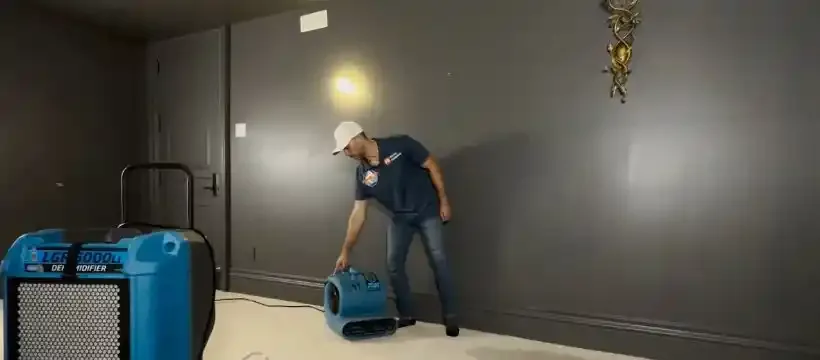
Industrial air movers and dehumidifiers placed to dry structure and materials.
Document
Moisture readings and photos recorded to support any insurance claim.
What Water Damage Restoration Costs
Extraction and drying for a contained area sits toward the lower end, multi-room or basement-wide jobs with material removal sit higher.
Water Damage Restoration In Franklin, TN
Spring in Williamson County brings the heaviest rainfall of the year, and that's when we see the sharpest spike in water damage calls tied to basement intrusion and overwhelmed sump systems. Summer thunderstorms add a secondary, shorter-duration risk. Either way, the first hour after water is discovered matters more than almost anything else in how the restoration goes, which is the entire reason this line runs around the clock rather than during normal business hours only.
Clean water from a burst supply line and water that has been sitting in a flooded basement for a day or two are treated differently, and that distinction matters for both the drying process and any insurance conversation. Water that's been standing longer picks up contaminants from the soil and building materials it's touched, which can move a job from straightforward extraction and drying into a more involved remediation. This is another reason a fast call matters: water caught within the first few hours is almost always still in the cleaner category.
We coordinate with a homeowner's broader restoration needs where relevant, flooring, drywall, and trim replacement fall outside plumbing scope, but we'll say plainly when a job has moved past what drying alone can fix so a homeowner isn't left guessing whether the next call is to a general contractor or back to us.
FAQsCommon Questions
We document the damage, source, and mitigation work with photos and notes a homeowner can submit to their carrier. We are not a public adjuster.
Our water damage line is answered 24/7, and dispatch for active water intrusion is treated as a priority call.
Sudden events like a burst pipe are typically covered, though policies vary. Gradual seepage and flood-related damage often are not. Check your specific policy.
In most cases, yes, based on the moisture path and staining pattern. When it genuinely could be either, we say so and help narrow it down before work begins.
Structural drying typically takes 3 to 5 days with equipment in place, though it depends on how much material absorbed water and the humidity level in the space. We monitor moisture readings rather than guessing when it's done.