Downtown Franklin and its surrounding older neighborhoods have a lot going for them, walkable streets, historic character, and mature tree canopy that took decades to grow in. That same tree canopy is also the most common reason homes in these neighborhoods deal with recurring sewer line clogs that homes in newer developments rarely see.
Newer Franklin developments like Westhaven and Berry Farms mostly sidestep this issue entirely, simply because their sewer laterals are younger PVC pipe with fewer joints prone to separation, and their landscaping hasn't had decades to develop the kind of root systems that cause problems. That contrast is useful context: root intrusion isn't a citywide plumbing risk so much as a specific, identifiable pattern tied to the combination of older pipe material and mature trees, which narrows down pretty clearly which Franklin properties are actually at elevated risk and which aren't.
If you're house hunting in Franklin's older neighborhoods specifically, this is a reasonable thing to ask a seller or agent about directly, whether the sewer lateral has ever had root intrusion issues or a camera inspection. It's not a dealbreaker either way, but it's useful information heading into ownership rather than something to discover the first time a drain backs up unexpectedly.
Why Roots Get Into Sewer Lines At All
Tree roots are drawn toward moisture and nutrients, and a sewer line carrying warm, nutrient-rich wastewater is exactly what a root system will grow toward given the chance. The entry point is almost never a fully intact pipe. It's a small crack, a separated joint, or a section of aging clay or cast-iron pipe where roots have exploited an existing weakness. Once inside, roots don't stay small. They branch and fill the available space, eventually forming a dense mass that catches paper, grease, and debris passing through the line.
Franklin's karst-clay soil plays a role here too. The same soil movement that drives basement water intrusion also causes slight shifting at underground pipe joints over years, which is exactly the kind of small opening a root system takes advantage of. Older clay and cast-iron sewer laterals, common throughout Franklin's historic core, are more susceptible to this joint separation than the PVC lines used in newer construction.
The Signs That Point To Roots Specifically
- A drain that clogs again within weeks, not months. A single, unrelated clog is normal. The same drain backing up repeatedly on a short cycle is the clearest sign something is sitting in the line rather than just occasional buildup.
- Multiple fixtures backing up at once. If a toilet, a shower, and a floor drain are all acting up around the same time, that points to a main line issue rather than an isolated fixture problem, and roots in the main lateral are a common cause in older neighborhoods.
- Gurgling sounds from drains not in use. Air trapped behind a partial obstruction pushing back up through other fixtures.
- Unusually lush, green patches of grass over the sewer line's path. Roots feeding on leaking wastewater nutrients sometimes show up as a visibly greener strip of lawn tracing the pipe's route.
What A Standard Snake Does, And Doesn't, Fix
A mechanical snake used for standard drain cleaning is effective at punching a hole back through a root mass and restoring flow, and for a lot of clogs, that's genuinely all that's needed. The catch with root intrusion specifically is that snaking clears a path through the roots without removing them from the pipe wall. Given a few months, the roots regrow into that same opening, and the homeowner is back to square one, sometimes paying for the same temporary fix three or four times before anyone looks at what's actually happening inside the line.
When Hydro Jetting Is The Better Call
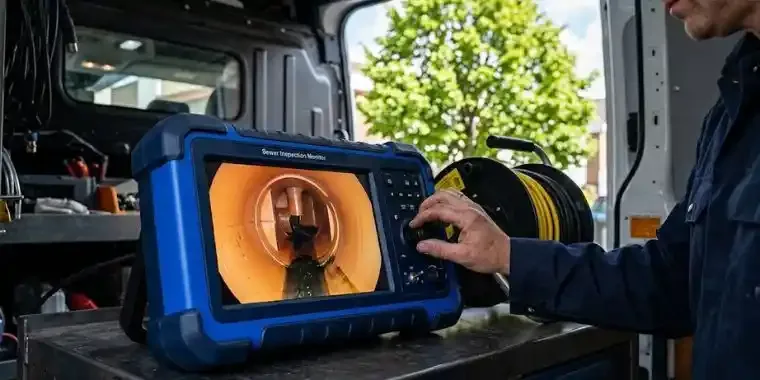
For lines with confirmed, recurring root intrusion, hydro jetting does something a snake can't: it uses high-pressure water to scour the entire interior diameter of the pipe, removing root growth along the pipe wall rather than just punching through the center. It typically holds longer for exactly this reason. We generally recommend a camera inspection first on a recurring-clog line, so a homeowner can see what's actually happening before deciding between another snaking visit and the more thorough jetting service.
Same drain backing up again?
☎ (615) 616-0512Which Trees Are The Usual Suspects
Not every tree poses the same risk. Species with aggressive, water-seeking root systems, willows, silver maples, and mature oaks among them, are more likely to cause sewer line intrusion than trees with more contained root structures. A lot of Franklin's historic-core streets were planted with exactly these larger shade species decades ago for good reason, they mature into the kind of tree canopy the neighborhood is known for, but that same maturity is what puts pressure on any nearby clay or cast-iron sewer lateral with an existing joint weakness. This isn't a reason to remove a mature tree over a plumbing concern. It's simply useful context for why a home with large trees near the sewer line's path is statistically more likely to see this issue than a newer property with younger landscaping.
Quick Answers
Will removing the tree fix the problem? Not necessarily. Roots already inside the pipe don't disappear when the tree is removed, and the underlying pipe joint weakness that let them in remains until it's repaired.
How often does a root-affected line need re-treatment? It varies. Some lines need jetting again within a year if the entry point isn't addressed, others go several years between service depending on how aggressive the root growth is.
Is chemical root killer a real solution? Over-the-counter root treatments can slow regrowth temporarily but don't remove existing root mass the way jetting does, and repeated chemical use isn't a substitute for addressing an underlying pipe defect.
Is There A Way To Prevent It?
Short of removing mature trees, which nobody wants to do for a plumbing problem, the realistic approach is staying ahead of it: if a property has a history of root intrusion, periodic camera checks and jetting on a schedule before symptoms return is usually cheaper over several years than a series of reactive emergency clog calls. It's also worth knowing where your sewer lateral actually runs relative to any large trees on the property, since that alone helps make sense of a recurring pattern.
Have a plumbing issue in Franklin, Brentwood, or Spring Hill?
☎ (615) 616-0512